Lab-on-a-Chip and Biomedical Microsystems
Microfluidic platforms for cell handling, cell mechanics, droplet generation, and biomedical measurement.
Research
IMLAB develops experimental platforms that connect microfluidics, plasma-enabled fabrication, robotic manipulation, and biomedical measurement.
Microfluidic platforms for cell handling, cell mechanics, droplet generation, and biomedical measurement.
Atmospheric-pressure plasma processes for fast, patternable surface treatment and bonding of microfluidic chips.
Robotic systems for high-speed manipulation, grasping, contact modeling, and micro-scale interaction.
Modeling and sensing of deformable contact interfaces for robotic manipulation and microsystem interaction.
Research highlight
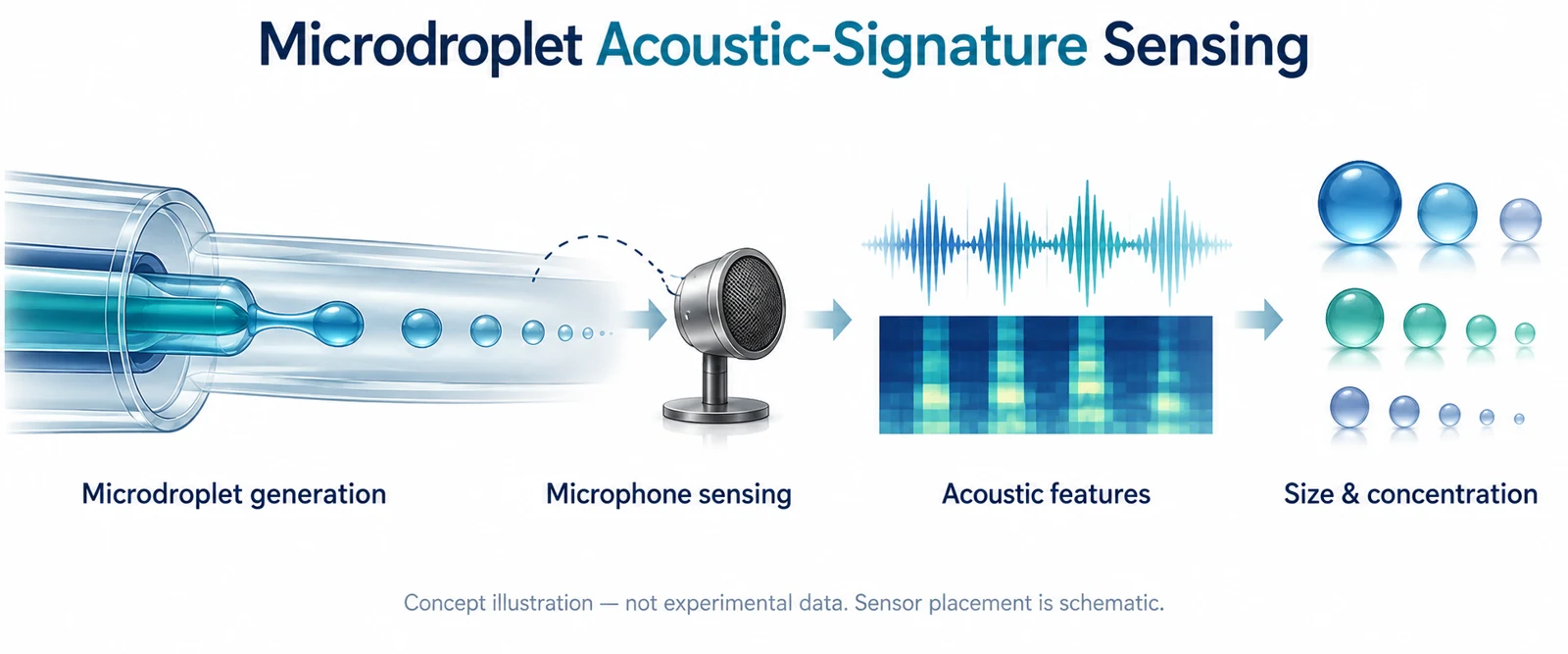
How can the generation state and characteristics of microdroplets be identified in a microfluidic device? IMLAB explores acoustic signatures as a source of sensing information. Here, “voiceprint” refers to acoustic features associated with droplet generation—not human speaker identification.
A 2024 study investigated voiceprint-based sensing of droplet generation and mode transitions in a coaxial microfluidic device. A 2026 study combined voiceprint features with a convolutional neural network (CNN) for label-free identification of sodium-alginate microdroplet size and concentration during high-frequency generation. Each study should be read within its own experimental conditions and validation scope.
微液滴在微流體裝置中生成時,如何辨識其生成狀態與特徵,是微流體量測的重要課題。IMLAB 探索以聲紋作為感測資訊:此處的「聲紋」指與液滴生成相關的聲學特徵,而非人聲身分辨識。
2024 年的研究探討同軸微流體裝置中的液滴生成與模式轉換感測;2026 年的研究進一步結合聲紋特徵與卷積神經網路(CNN),用於高頻生成過程中海藻酸鈉微液滴尺寸及濃度的無標記辨識。各自適用條件與驗證範圍仍以原論文為準。上圖為概念示意,非實驗裝置照片或量測結果。
The lab integrates microfabrication, plasma treatment, microscopy, high-speed imaging, and robotic testbeds for microsystem experiments.
Intelligent Microsystem Lab welcomes collaborations across microfluidics, biomedical devices, robotics, and plasma-enabled manufacturing.